
















General Information
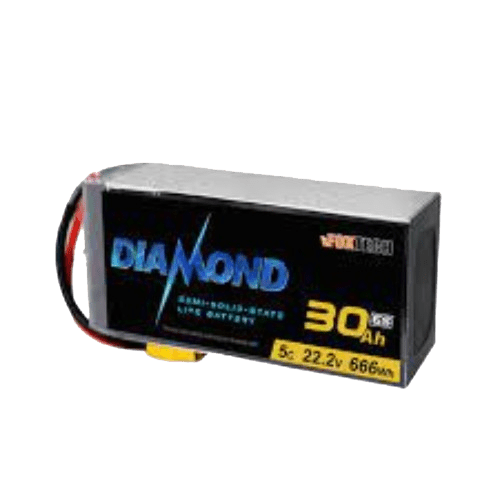
To ensure that the motor and propeller deliver the required performance, they must be supplied with sufficient power. Lithium batteries offer an excellent balance between capacity and weight. Thanks to their high discharge rates and suitable shape, Lithium-Polymer batteries (commonly abbreviated as LiPo or Li-pol) are the most widely used in RC models. These batteries do not suffer from the memory effect, can be recharged from any charge level, do not require forming, and their self-discharge is minimal. However, LiPo batteries require proper care.
A single battery cell has a nominal voltage of 3.7V. In practice, the voltage depends on the battery’s state of charge. LiPo batteries consist of individual cells connected in series. With a series connection, the total battery voltage increases—hence designations such as 2S (7.4V), 3S (11.1V), 4S (14.8V), and so on.
You will usually find two connectors on a battery. The main power connector connects the battery to the model, and the balance connector is used for monitoring individual cells. The main connector is wired to the first and last cell and carries the battery’s total voltage. The connector type is usually chosen based on the battery’s discharge current. The balance connector has multiple contacts (number of cells + 1) and is used to monitor the voltage of each cell.
The capacity of a battery is usually given in mAh (milliamp-hours). Capacity tells us how much current the battery can supply over one hour. It is always related to a single cell, so the energy stored in a battery is the product of its capacity and voltage. The specified capacity is nominal—actual usable capacity may vary depending on the discharge rate and ambient temperature.
Another important value is the discharge current. It is indicated in multiples of C, where C is the battery’s capacity. Multiplying these values gives the battery’s maximum discharge current. For example, for a 1500mAh 100C battery (1.5*100=150), it can be discharged at up to 150 amps. For safe operation, the continuous current should be lower. The charging current is indicated in the same way.
Usage and Safety
LiPo batteries must be handled properly. When used correctly, they are safe. Ignoring safety procedures can lead to battery damage or, in extreme cases, fire. The seller is not responsible for damages caused by improper battery use.
- Do not use damaged, swollen, or otherwise defective batteries.
- Follow proper charging guidelines.
- Discharge batteries at temperatures between 10–50°C. In colder months, preheat batteries before use.
- Do not over-discharge batteries. Land the model at 3.5V per cell under load. Dropping below 3.0V per cell may result in irreversible damage.
- Do not exceed the maximum discharge current. Excessive current heats the battery and causes voltage drops. Over time, the battery may swell.
- Never short the battery terminals.
- Always disconnect the battery from the model after flying.
- Do not throw batteries into fire.
- Store batteries away from flammable objects at temperatures up to 30°C. Use a fireproof bag for storage and charging.
- Store batteries (for 14 days or more) at a storage voltage of 3.8V per cell.
- Do not place batteries in water.
- Do not puncture, disassemble, or modify batteries—fire hazard!
Charging Batteries
After each use, the battery must be recharged. Follow these rules for safe and reliable charging.
- Always charge LiPo batteries with a professionally designed charger intended for LiPo batteries.
- Do not exceed 4.2V per cell (4.35V for HV batteries).
- Do not exceed the recommended charging current. The standard rate is 1C. Higher-quality LiPo batteries may allow 3C or even up to 5C as specified by the manufacturer. Always follow the manufacturer’s recommendations.
- Always charge with the balance connector connected. If possible, use the Balance charging mode.
- NEVER LEAVE CHARGING BATTERIES UNATTENDED! If possible, monitor individual cell voltages and battery temperature.
- Charge batteries on a fireproof surface or in a fireproof bag.
- Check the number of cells and charging current carefully before charging.
Battery Disposal
Damaged or defective batteries must be disposed of in an environmentally friendly way. LiPo batteries must not be thrown into regular trash. Discharge the battery before disposal. Hand it over to a collection site or drop it into a red battery container.